
NEET MDS MCC Counselling is one of the most important counselling processes for MDS aspirants in India. It is especially beneficial for candidates who want to secure a Government Dental College through the 50% All India Quota (AIQ), seek admission to prestigious institutions such as MAIDS, BHU, and AMU, or explore some of the best Deemed Universities in the country.
Hello Doctor 👋, First of all, congratulations on completing your NEET MDS 2026 examination. Reaching the counselling stage itself is a significant achievement, and you should be proud of the effort you have put into your journey so far. Now that the exam is behind you, the focus shifts to the next crucial step—MCC Counselling.
For many aspirants, counselling often feels more confusing than the examination itself. Questions about eligibility, college options, counselling rounds, fees, documents, reservation policies, and choice filling strategies can quickly become overwhelming. A small mistake during counselling can sometimes cost a candidate a much better seat than their rank actually deserves.
That is exactly why I created this guide. My goal is to simplify the entire NEET MDS MCC Counselling process and explain everything in a practical and easy-to-understand manner. Whether you are aiming for a Government Dental College, a Central University, or a Deemed University, this guide will help you understand the rules, avoid common mistakes, and make better counselling decisions.
This guide will be updated at frequent intervals as new information, notifications, and counselling updates are released. Therefore, I highly recommend bookmarking this page so you can revisit it throughout the counselling season.
Latest Update — 16 August 2026
- MCC has released the NEET MDS Counselling 2026 Information Bulletin.
- MCC has released the AIQ & State Counselling Schedule.
- Round 1 registration begins on 18 August 2026.
- Round 1 choice filling begins on 19 August 2026.
- Round 1 result is scheduled for 26 August 2026.
- Round 1 reporting runs from 27 August to 1 September 2026.
As I am covering the complete MCC counselling process in detail, this article is naturally going to be quite long. I recommend reading it patiently from start to finish. However, if you are looking for specific information, you can use the “What’s Inside” section to quickly jump to the topic that interests you.
This guide has been exclusively prepared by the @aspirantsonly Research Desk based on extensive research, official NEET MDS Information Bulletins issued by NBEMS, MCC counselling guidelines, previous counselling data, seat allotment trends, and expert counselling insights. Every effort has been made to ensure that the information is practical, accurate, and useful for aspirants participating in MCC counselling.
By the end of this guide, you should have a clear understanding of how MCC counselling works and what strategy you should follow based on your rank, budget, and career goals.
What's Inside
NEET MDS MCC Counselling Overview
First, let’s understand the MDS admission process in India and the role of MCC.
As you know, MDS admission in India is structured in a way where you need to qualify for the NEET MDS exam. After qualifying for the exam, there is a single-window admission process (called the counselling process) where you have to register and participate to get allotted to your preferred college.
NEET MDS counselling is managed in two different ways:
- Centrally by MCC Counselling (All India Counselling)
- State Counselling (where the state has its own counselling authority to manage the counselling process)
NEET MDS admission has multiple counselling routes. MCC conducts national counselling for eligible AIQ, Deemed University, and participating Central University/Institute seats, while State authorities conduct their respective state counselling.
Now let’s understand the role of MCC Counselling in the MDS admission process.
MCC stands for Medical Counselling Committee. NEET MDS counselling under MCC is the centralized national counselling system for MDS admissions in India. MCC operates under the Directorate General of Health Services (DGHS), Ministry of Health & Family Welfare, Government of India.
All admissions are made strictly based on the NEET MDS All India Merit List provided by NBEMS. The MCC counselling process uses an online system for registration, fee payment, choice filling, seat allotment, document upload, upgradation, and resignation.
However, reporting requirements depend on the candidate’s status. Freeze candidates must physically report to the allotted institute, while Float candidates can complete the applicable Round 1 and Round 2 document verification and upgradation process online. Physical reporting becomes mandatory for applicable candidates after Round 3 allotment. Offline admission and offline resignation are not accepted.
Why MCC Counselling Matters?
MCC counselling is important because it gives candidates access to some of the most sought-after MDS seats in India, including Government Dental Colleges under the 50% All India Quota, Central Universities, and Deemed Universities. A single registration can make a candidate eligible for thousands of seats across multiple institutions.
MCC Counselling Overview Snapshot
| Particulars | Details |
|---|---|
| Conducting Authority | Medical Counselling Committee (MCC) |
| Admission Basis | NEET MDS Rank |
| Counselling Mode | Online |
| Rounds | Round 1, Round 2, Round 3, Stray Vacancy |
| Eligible Candidates | NEET MDS Qualified Candidates |
| 2026 Upgradation System | Freeze / Float |
| Seat Types Covered | AIQ, Central Universities, Deemed Universities, AFMS |
In India, dental colleges are commonly divided into Government, Private, and Deemed Universities. There are also special categories such as Central Universities and Institutes like MAIDS (Delhi University), BHU (Banaras Hindu University), AMU (Aligarh Muslim University), and AFMS (Armed Forces Medical Services).
MCC plays a crucial role in MDS admissions across these institutions. For Deemed Universities MDS admission, MCC conducts the counselling process and manages 100% of MDS seats. Similarly, 50% of MDS seats in Government Dental Colleges across India are classified as All India Quota (AIQ) seats, and MCC exclusively manages these seats. Certain seats in Central Universities such as MAIDS (DU), BHU, and AMU, as well as seats under Armed Forces Medical Services (AFMS), are also filled through MCC in coordination with DGAFMS.
This means colleges cannot admit students directly to seats covered under MCC counselling. Candidates must first register for MCC counselling and participate in the counselling process to become eligible for seat allotment. Any admission to MCC-covered seats outside the official counselling process is not permitted.
To make it easier to understand, here’s a quick breakdown:
| Seat Type | Who Runs Counselling? | Seats Covered |
|---|---|---|
| 50% All India Quota (AIQ) | MCC | Government Dental Colleges across India |
| Deemed Universities (100%) | MCC | Includes General, NRI Quota, and Minority Quota |
| Central Universities (MAIDS-DU, BHU, AMU) | MCC | AIQ and Institutional Quota Seats |
| AFMS (Armed Forces Medical Services) | MCC + DGAFMS | Priority-Based Selection |
Central institutions:
- 50% AIQ seats → domicile-free
- 50% institutional/internal seats → institution-specific eligibility
For DU, 50% seats go to AIQ and candidates who completed BDS from Delhi University can be eligible for the 50% internal quota. AMU and BHU also have separate internal-quota eligibility rules.
AIQ seats ≠ institutional seats.
Not Included Under MCC
Private Dental College seats are filled only through the respective State MDS Counselling Authorities. Reservation rules are also state-specific. MCC has no role in these seats.
MCC AIQ seats and 100% Deemed University seats are domicile-free. However, institutional/internal quota seats in Central Universities and Institutes can have separate eligibility conditions.
NEET-MDS Counselling 2026 Information Bulletin explicitly says the 50% AIQ Central University seats are domicile-free, while institutional eligibility is determined by the concerned institution.
Seat allotment is made through MCC’s automated software based on three factors:
- All India Rank
- Candidate’s Choice List
- Seat Availability
No one—not the college, agent, or MCC official—can override the system once choices are locked.
MCC is not just a platform for distributing seats. It is a strict, transparent, and rule-driven system where the entire outcome depends on your rank, the rules, and the choices you submit.
I have also published a detailed guide on Total MDS Seats in India, where I have explained the complete seat distribution across Government Dental Colleges, Deemed Universities, Central Universities, and Private Dental Colleges. I highly recommend reading that article as well before participating in counselling.
NEET MDS MCC Counselling Eligibility
Now, I hope you got a solid answer to the question “What is MCC Counselling?”
Now let’s understand the eligibility criteria for participating in NEET MDS MCC Counselling. Talking about eligibility, I would like to call it the “Four Pillars of MCC Counselling Eligibility” because it explains the four basic requirements you must fulfill to participate in NEET MDS MCC Counselling.
To participate in MCC NEET MDS Counselling, a candidate must first qualify NEET MDS, which is conducted by NBEMS. MCC does not conduct the exam; it only receives the list of qualified candidates from NBEMS and allots seats based on merit rank and the choices submitted by candidates.
Once qualified, counselling eligibility remains provisional until document verification and eligibility checks are completed during the admission process.
Counselling has started. Prepare your college choices using your rank, branch preference, budget, fees, and previous closing ranks before you lock your choices.
Built around your rank. Get a college shortlist with Round 1–3 predictions for MCC and your state counselling — delivered within 48 hours.
- Your rank analysed against actual closing data
- Safe, moderate and reach college categories
- MCC + up to 2 state counselling routes
- Round 1 to Round 3 allotment predictions
- Management and NRI quota assessment
- Personalised choice filling strategy
- Delivered to WhatsApp or Email
Full round-wise data for MCC and state counselling — opening and closing ranks, fee structures, bond rules, and choice filling strategy for 2026.
- College-wise opening and closing ranks
- All 4 MCC rounds + Stray Vacancy data
- Branch-wise and quota-wise analysis
- Fee structure and hidden charges
- Bond rules — state-wise
- Round-wise upgrade strategy
- Mistakes to avoid during choice filling
Not sure which one you need? Get the Personalised Report if you want a college shortlist based on your rank. Get the Counselling Guide if you want detailed round-wise data, fees, bond rules, closing ranks, and choice-filling strategy.
The Four Pillars of MCC Counselling Eligibility
1. NEET MDS Qualification (NBEMS Requirement)
You must qualify NEET MDS to participate in MCC counselling. NBEMS prepares the merit list, and MCC uses this merit list for seat allotment.
It is important to understand that qualifying NEET MDS alone does not guarantee admission to an MDS seat. Candidates must also satisfy all eligibility conditions, document verification requirements, and admission rules prescribed by the concerned authorities and institutions.
| Requirement | Explanation |
|---|---|
| Must qualify NEET MDS | NBEMS declares the NEET MDS merit list, and MCC uses it for counselling and seat allotment. |
| Minimum percentile required | The qualifying percentile may be reduced by the authorities if required due to vacant seats. |
| Merit-based allotment | MCC allots seats based on NEET MDS rank and candidate choices. |
2. Educational Qualification, Internship & Registration
Apart from qualifying NEET MDS, candidates must also satisfy the educational and registration requirements.
| Criteria | Requirement |
|---|---|
| BDS Degree | Must have completed BDS from a DCI-recognized dental college. |
| Internship | Must complete the compulsory 12-month rotatory internship by 31 May 2026. |
| Dental Registration | Must possess provisional or permanent registration with the State Dental Council or DCI. |
| Foreign Graduates | Must comply with DCI regulations and obtain the required registration, wherever applicable. |
The internship completion date declared by the candidate is treated as final. Candidates must produce the original internship completion certificate during counselling and admission.
Candidates Already Pursuing MDS
Some universities and institutions do not allow admission to candidates who are already pursuing an MDS course until the existing course is completed. Candidates who are already studying MDS through All India Quota or State Quota should verify the eligibility rules of the concerned university before participating in counselling.
3. MCC Counselling Registration & Domicile Rules
MCC only conducts counselling for 50% All India Quota (AIQ) seats, Deemed Universities, Central Universities, AFMS institutions, and other participating institutes.
Private dental college seats are generally filled through the respective State Counselling Authorities.
| Rule | Requirement |
|---|---|
| MCC Registration | Candidates must register on the MCC portal to participate in counselling. |
| Domicile Requirement | No domicile is required for MCC All India Quota counselling. |
| Eligibility Status | Eligibility remains provisional until reporting and document verification are completed. |
One of the biggest advantages of MCC counselling is that it is domicile-free, which means candidates from any state can participate for eligible MCC seats across India.
Even after seat allotment, admission can be cancelled if a candidate fails document verification or is later found ineligible under the prescribed rules.
4. Citizenship, OCI & NRI Eligibility
Candidates applying under Indian, OCI, or NRI categories must satisfy the applicable eligibility requirements.
| Category | Eligibility |
|---|---|
| Indian Citizens | Eligible for AIQ, Central Universities, and Deemed University seats. |
| OCI Candidates | Eligible as per the prevailing rules and regulations. |
| NRI Candidates | Eligible for NRI quota seats in participating institutions subject to document verification. |
| NRI Conversion | Allowed only within the timelines prescribed by MCC and subject to submission of supporting documents. |
Candidates claiming NRI status may be required to submit documents such as:
- Passport and Visa of the sponsor
- Relationship proof
- Sponsorship affidavit
- Embassy certificate (if applicable)
- NEET MDS scorecard
- Family tree and supporting documents
NRI Sponsorship Rules
Candidates applying under the NRI quota must satisfy the eligibility conditions prescribed by the Supreme Court and MCC.
Generally, the following persons can sponsor an NRI candidate:
- Father or Mother residing abroad as an NRI
- First-degree relatives residing abroad as an NRI
- Certain blood relatives such as:
- Real Uncle or Aunt (Father’s side)
- Real Uncle or Aunt (Mother’s side)
- Grandfather or Grandmother
- Maternal Grandfather or Grandmother
- First-Degree Cousins
The sponsor must be an NRI residing abroad, and candidates may be required to provide documentary proof showing that the sponsor is a genuine legal guardian and financial sponsor. MCC may also require affidavits and supporting legal documents during counselling.
Important: NRI eligibility is verified during counselling. If the required documents are not produced, the candidate may lose eligibility for NRI quota seats.
Quick Summary Table
| Eligibility Component | Mandatory |
|---|---|
| Qualified NEET MDS | Yes |
| BDS from DCI-Recognized College | Yes |
| Internship Completed by 31 May 2026 | Yes |
| Registration with DCI / State Dental Council | Yes |
| MCC Counselling Registration | Yes |
| Domicile for AIQ Seats | Not Required |
| NRI Claim with Supporting Documents | Yes (if applicable) |
📌Important Note: Eligibility for counselling remains provisional. Even if a candidate qualifies NEET MDS, registers for counselling, or receives a seat allotment, admission is confirmed only after successful document verification and completion of admission formalities at the allotted college.
NEET MDS MCC Counselling Dates
The MCC NEET MDS Counselling 2026 schedule has been released for 50% All India Quota (AIQ), Deemed Universities, and Central Universities. MCC will conduct counselling in four stages: Round 1, Round 2, Round 3, and Stray Vacancy Round. The counselling schedule also specifies the last date for joining after each round.
| Event | Date |
|---|---|
| NEET MDS 2026 Application Starts | 14 March 2026 |
| NEET MDS 2026 Application Ends | 30 March 2026 |
| NEET MDS 2026 Admit Card Release | 29 April 2026 |
| NEET MDS 2026 Exam Date | 02 May 2026 |
| Internship Completion Deadline | 31 May 2026 |
| NEET MDS 2026 Result Date | 02 June 2026 |
| MCC Round 1 Counselling | 18 August – 26 August 2026 |
| Last Date to Join Round 1 Seat | 01 September 2026 |
| MCC Round 2 Counselling | 03 September – 11 September 2026 |
| Last Date to Join Round 2 Seat | 18 September 2026 |
| MCC Round 3 Counselling | 22 September – 30 September 2026 |
| Last Date to Join Round 3 Seat | 08 October 2026 |
| MCC Stray Vacancy Round | 12 October – 16 October 2026 |
| Last Date to Join Stray Vacancy Seat | 24 October 2026 |
| Commencement of MDS Academic Session | 17 September 2026 |
The official schedule states that Round 1 will run from 18 August to 26 August 2026, followed by Round 2 from 3 September to 11 September, Round 3 from 22 September to 30 September, and the Stray Vacancy Round from 12 October to 16 October 2026. The academic session for MDS courses is scheduled to commence on 17 September 2026.
Important: MCC 2026 Counselling Schedule vs Registration Dates
The schedule PDF provides the round-wise counselling and admission timeline, but it does not separately list every individual date for registration, fee payment, choice filling, choice locking, and result publication within each round. MCC may publish these detailed sub-schedules through separate notices. Candidates should therefore check the latest MCC notice before completing registration, choice filling, or reporting. MCC specifically advises candidates to regularly check the MCC website for the latest schedule, results, notices, and counselling updates.
Important Note: Candidates should keep all required documents ready before counselling begins, including the NEET MDS scorecard, BDS degree/provisional degree certificate, internship completion certificate, Dental Council registration certificate, category certificate (if applicable), and other documents required by MCC or the allotted institute.
For 2026, candidates should also keep clear scanned copies of their documents ready because MCC requires candidates to upload scanned documents during the counselling process. In Round 2, for example, both Freeze and Float candidates must submit scanned documents on the MCC portal.
What’s New in NEET MDS MCC Counselling 2026?
The NEET MDS MCC Counselling 2026 process introduces several important changes compared with the counselling system followed until 2025. The biggest change is the introduction of the Freeze and Float system, which changes how candidates handle seat retention, upgradation, document verification, and reporting.
Under the previous system, candidates generally had to physically report to their allotted institute to complete admission formalities and submit their willingness for upgradation. In 2026, MCC has introduced an online process for candidates who want to upgrade their seats, making the counselling process more convenient and reducing the need for repeated physical visits to colleges.
1. Freeze and Float System Introduced
After a candidate receives a seat allotment, the candidate is now divided into one of two categories based on their willingness for upgradation:
| Status | Meaning | What the Candidate Must Do |
|---|---|---|
| Freeze | Candidate does not want upgradation | Physically report to the allotted institute and join the seat |
| Float | Candidate wants upgradation | Give willingness for upgradation online and complete online document verification |
This applies to candidates who want to upgrade from Round 1 to Round 2 or from Round 2 to Round 3.
Freeze Candidate — No Upgradation
A Freeze candidate is a candidate who is satisfied with the allotted seat and does not want to participate in upgradation to the next round.
For example:
- Round 1 seat → Candidate does not want a better seat in Round 2.
- Round 2 seat → Candidate does not want a better seat in Round 3.
The candidate must physically visit the allotted institute and complete the admission process.
The Freeze process includes:
- Physically report to the allotted institute.
- Submit the required original documents.
- Complete physical document verification.
- Pay the admission fee at the institute.
- The institute verifies the documents.
- If the documents are valid, the admission is confirmed and the seat is finalized.
- If a discrepancy is found in the documents, the admission may be cancelled.
Important: Choosing Freeze means you are not opting for upgradation in the next round.
Float Candidate — Wants Upgradation
A Float candidate is a candidate who is satisfied enough to retain the currently allotted seat temporarily but wants to compete for a better seat in the next round.
For example:
Round 1 seat → Float → participate in Round 2
or
Round 2 seat → Float → participate in Round 3
The major advantage of the 2026 system is that a Float candidate does not need to physically visit the allotted institute during Rounds 1 and 2 just to complete the upgradation process. The candidate gives willingness for upgradation through the MCC portal and completes online document verification.
The Float process works as follows:
- Give willingness for upgradation through the MCC portal.
- Upload the required documents.
- The allotted institute verifies the documents online.
- If the documents are correct, the seat receives provisional confirmation.
- The candidate becomes eligible for the next round according to the applicable rules.
- The candidate then participates in fresh choice filling for the next round.
2. Online Document Upload Is Now Mandatory
Another important 2026 change is the introduction of a one-time online document upload process.
Both Freeze and Float candidates must upload clear scanned copies of their required documents on the MCC portal within the prescribed reporting period.
MCC recommends that candidates upload their documents within 2–3 days after the declaration of the final allotment result rather than waiting until the last day.
Freeze Candidates
Freeze candidates will:
Upload documents online → Physically report → Submit original documents → Physical verification → Pay admission fee → Admission decision
If the documents are valid, the institute confirms the admission and finalizes the seat. If the institute finds discrepancies, the admission may be cancelled.
Float Candidates
Float candidates do not proceed for physical document verification during the applicable Round 1 or Round 2 process.
Instead:
Upload documents online → Institute verifies online → Discrepancy, if any, is raised → Candidate corrects/re-uploads documents → Institute re-verifies → Provisional confirmation → Next-round participation
3. Float Candidates Can Complete Document Verification Online
The allotted institute’s nodal officer will verify the documents uploaded by a Float candidate online.
The institute may identify problems such as:
- Blurred document copies
- Incorrect certificates
- Mismatch between the candidate’s claims and submitted documents
- Missing documents
If the institute detects an issue, its Document Verification Committee (DVC) can raise a query with the candidate. The candidate must then re-upload the corrected or missing documents within the prescribed timeline.
After re-uploading, the institute’s nodal officer or DVC will conduct another verification.
The outcome can be:
Documents accepted
The candidate receives provisional seat confirmation and becomes eligible for the next round according to the applicable rules.
Documents rejected
If the documents do not support the candidate’s claims, the seat may be cancelled. Eligibility for the next round will then depend on the applicable counselling rules.
4. Upgradation Is Allowed Up to Round 3
One of the important changes for 2026 is that candidates can now upgrade their seats through Round 3.
The MCC bulletin states that candidates can upgrade:
Round 1 → Round 2
and
Round 2 → Round 3.
However, Round 3 is different.
Once a candidate joins a Round 3 allotted seat, the candidate cannot resign from that seat and cannot participate in any further MCC counselling round.
Therefore, Round 3 should be treated as a final commitment round.
5. Physical Reporting Becomes Mandatory After Round 3
The online Float system is mainly designed to make Round 1 and Round 2 upgradation easier.
After the Round 3 provisional allotment result, physical reporting becomes mandatory for:
- Candidates freshly allotted a Round 3 seat.
- Float candidates from Round 1 who did not get upgraded.
- Float candidates from Round 2 who did not get upgraded.
These candidates must physically report to their allotted institute and complete the admission process.
A candidate allotted a Round 3 seat must join the seat.
If the candidate does not join:
- The security deposit is forfeited.
- The candidate cannot resign from that Round 3 seat.
- The candidate cannot participate in further counselling rounds.
6. Online Resignation / Seat Surrender Is Introduced for Float Candidates
The 2026 scheme also changes how candidates can surrender or resign from seats.
Candidates with provisional admission can submit a seat surrender request online with the required supporting documents.
Freeze Candidate
A Freeze candidate must physically visit the allotted institute to submit the resignation.
The candidate can resign from a Round 1 or Round 2 seat within the prescribed timeline and become eligible for the next round according to the applicable resignation rules.
However, a candidate cannot resign from a Round 3 allotted seat.
Float Candidate
A Float candidate can submit the resignation/surrender request online.
The process is:
- Log in to the Candidate Login section on the MCC portal.
- Select “Resignation/Surrender.”
- Submit the resignation online.
- Complete the process within the timeline prescribed by MCC.
A Float candidate can resign from a Round 1 or Round 2 seat according to the applicable rules, but cannot resign from a Round 3 allotted seat.
Once a candidate surrenders or resigns from a seat, the candidate has no further claim on that particular seat.
7. MCC Has Introduced Clear-Cut and Virtual Vacancies
The 2026 counselling scheme also clarifies how vacancies will be displayed during different rounds.
Round 1 — Clear-Cut Vacancies
In Round 1, candidates will be shown only clear-cut vacancies.
These are seats that are actually available for allotment at that stage.
Round 2 — Clear-Cut + Virtual Vacancies
Round 2 will show two types of vacancies:
Clear-Cut Vacancy: A seat that was not allotted in Round 1.
Virtual Vacancy: A seat currently occupied by a Round 1 candidate who has opted for upgradation.
A virtual vacancy can be selected during Round 2 choice filling. However, the seat will actually become available only if the Round 1 candidate vacates or upgrades from that seat in Round 2.
The same principle applies to Round 3.
This means a seat shown as a virtual vacancy is not automatically vacant. It becomes available only if the existing candidate moves out of that seat.
8. MCC and State Counselling Will Share Joined-Candidate Data
Candidates participating in both MCC and State counselling need to understand an important part of the 2026 system.
MCC and State counselling authorities will share joined-candidate data with each other for seat processing.
The 2026 schedule specifically provides for the sharing of joined-candidate data between MCC and State counselling authorities before later-round processing.
This means candidates cannot assume that they can continue holding seats in different counselling systems without consequence.
For example, if a candidate wants to join a State-allotted seat after receiving an MCC AIQ seat, the candidate must follow the prescribed resignation/surrender process for the MCC seat. The MCC flow chart specifically shows this interaction between AIQ and State counselling.
9. No Offline Admission or Offline Resignation
MCC has clearly stated that offline admissions and offline resignations are not accepted.
All admission and resignation processes covered under MCC counselling must be recorded through the prescribed online MCC/Intra-MCC system.
If a college takes admission offline, MCC states that the seat may be treated as vacant for the next counselling round.
If a college accepts an offline resignation, the vacated seat will not be taken into the next round.
Candidates should therefore make sure that their admission or resignation is properly generated through the Intra-MCC portal by the college authorities.
A separate offline admission or resignation letter is not sufficient under the MCC scheme.
10. Candidates Must Register Themselves on the MCC Portal
MCC advises candidates to complete the counselling registration themselves rather than through an agent or third party.
The registration must be submitted online through the MCC website. Applications submitted through other modes will be rejected.
A candidate can submit the NEET MDS counselling registration only once. If a candidate submits more than one registration, MCC states that the candidate may be debarred from the allotment process and the candidature may be cancelled.
Never give your MCC registration to an agent claiming that they can guarantee a seat. MCC states that there is no direct entry or nomination to participating colleges.
11. Your NEET MDS Registration Mobile Number and Email ID Will Be Used
Candidates should use the same mobile number and email ID used during NEET MDS registration when registering for MCC counselling.
MCC states that these details will be used or pre-populated during counselling registration, and OTPs will be sent to the registered mobile number and email ID.
Candidates with an international mobile number must provide an alternative Indian mobile number during MCC counselling registration.
12. PwBD Candidates Must Obtain the Eligibility Certificate Before Choice Filling
A significant 2026 requirement applies to candidates claiming PwBD/PwD seats.
Candidates must obtain an Eligibility Certificate from a designated Primary Medical Assessment Board through the prescribed online process before choice filling begins.
Only candidates who obtain the required Eligibility Certificate through the designated centres will be eligible to see and fill PwD choices.
MCC has provided the list of designated medical assessment boards and the applicable NMC guidelines separately in the bulletin.
13. MCC Can Modify the Counselling Instructions
MCC has reserved the right to alter, amend, modify, or apply any of the instructions or guidelines contained in the Information Bulletin.
Candidates should therefore regularly check the official MCC website for the latest schedule, notices, results, and counselling instructions.
MCC also states that if there is any ambiguity in the interpretation of counselling rules, eligibility criteria, registration instructions, or other terms, the interpretation of MCC/DGHS will be final and binding.
14. Refunds Will Begin Only After All Counselling Rounds
Candidates should not expect their refundable security deposit to be processed immediately after their individual counselling round.
MCC states that the refund process will begin only after completion of all counselling rounds. MCC will not entertain refund-related queries before the completion of the entire counselling process.
What These Changes Mean for You
The 2026 MCC counselling system is designed to reduce unnecessary physical visits and make the upgradation process more convenient.
The most important change is simple:
Want to keep your seat and stop upgrading? → Freeze
You must physically report and join the allotted institute.
Want to keep your seat while trying for a better seat? → Float
You can give online willingness for upgradation and complete online document verification instead of physically reporting during the applicable Round 1/2 process.
The NEET MDS MCC Counselling 2026 Flow
Understand what happens after each stage of counselling.
No Upgradation
You are satisfied with your allotted seat. Physically report to the allotted institute, complete document verification and join the seat.
Want Upgradation
Give willingness for upgradation online. Upload your documents and complete online document verification by the allotted institute.
✍️My Take: Do not choose Freeze or Float casually. Understand the consequences before submitting your willingness. In 2026, this decision directly determines whether you physically report to the allotted institute or continue through the online upgradation process.
NEET MDS MCC Counselling Process
Now in this section, I will explain “How NEET MDS MCC Counselling Works?”
MCC NEET MDS counselling uses an online system for registration, fee payment, choice filling, seat allotment, document upload, upgradation, and resignation. However, the reporting process depends on whether a candidate chooses Freeze or Float after seat allotment. Freeze candidates must physically report to the allotted institute, while Float candidates can complete the applicable upgradation process through online document verification.
Seat allocation happens only through MCC software based on the candidate’s All India Rank, choice preferences, reservation rules, and seat availability.
The 2026 counselling process follows this basic sequence:
Registration → Fee Payment → Choice Filling → Seat Allotment → Freeze or Float → Document Verification → Joining / Upgradation → Further Rounds
Allotment is purely merit + choice-based. MCC does not modify or edit choices on behalf of candidates, and once choices are locked, they cannot be changed.
Step 01: Registration to NEET MDS MCC Counselling portal
The candidate registers on the MCC portal (NEET MDS 2026 MCC Counselling Registration official website will be available after June 2nd 2026) using the NEET MDS Roll Number, Date of Birth, and other required credentials.
The 2026 bulletin confirms that a candidate can submit the registration only once. Multiple registrations can result in debarment/cancellation.
Candidates should carefully verify their personal details, category, contact information, and other particulars while registering. MCC uses the information submitted by the candidate throughout the counselling process, and incorrect information may create problems during verification.
After entering personal and academic details, the candidate proceeds to the fee payment stage. Communication regarding allotment, reporting, resignations, and deadlines is sent only to the registered mobile number and email ID.
Candidates should use the mobile number and email ID used during NEET MDS registration. MCC will use these details during counselling, and OTPs will be sent to the registered mobile number and email ID.
Candidates with an international mobile number must provide an alternative Indian mobile number during MCC counselling registration.
💡Pro Tip: Try to use the mobile number and email ID linked to your Aadhaar while registering for NEET MDS MCC Counselling. If your mobile number or email ID is not linked to Aadhaar, consider updating it before the counselling process begins. It is also a good idea to upload and store all important documents on DigiLocker, such as your NEET MDS scorecard, BDS degree certificate, internship completion certificate, Dental Council registration certificate, and identity proof. This makes it easier to access documents quickly during counselling, reporting, and document verification.
📌Important Principle: Registration gives access to counselling. It does not guarantee a seat.
Step 02: Fee Payment
Before participating in choice filling, candidates must pay the prescribed counselling fee.
The counselling fee generally consists of:
- Non-Refundable Registration Fee
- Refundable Security Deposit
The exact fee varies depending on the institution type and counselling category selected by the candidate.
After fee payment, you will receive a password or login-related communication on your registered mobile number and email ID. Make sure both remain active throughout the counselling process because MCC sends important updates, allotment information, and counselling-related communications only through these registered contact details.
📌Important Principle: Without successful fee payment, a candidate cannot proceed to choice filling.
Step 03: Choice Filling and Locking
After successful registration and fee payment, MCC will give you can update on choice filling to fill college and specialization preferences in the order of priority.
MCC allows candidates to fill a large number of college and specialty choices. MCC does not reorder or correct choices later. The software considers only the sequence submitted by the candidate.
Candidates can add, delete, modify, and rearrange choices multiple times until the choice-locking deadline.
If choices are not locked manually, the portal automatically locks the last saved choices at the deadline.
Once locked, choices cannot be changed under any circumstances.
💡Choice Filling Tip: Before starting choice filling and choice locking, make sure you have prepared a list of at least 50 colleges that match your expected rank, score, budget, and branch preference.
Create a simple spreadsheet and arrange colleges from most preferred to least preferred. Your sheet should ideally contain:
- Institute Name
- Institute Code
- Branch / Specialty
- Annual Fees
- Previous Year’s Closing Rank
- Your Personal Preference Ranking
During MCC choice filling, every college and specialty combination is identified by a unique Institute Code. These codes are displayed on the MCC choice-filling dashboard and are also available in MCC’s seat matrix and participating institute lists.
Having a pre-prepared choice sheet helps you fill choices faster, reduces confusion during locking, and prevents common mistakes such as selecting the wrong college, missing preferred institutes, or arranging choices in the wrong order.
✍️My Recommendation: Never start choice filling directly on the MCC portal. First prepare your complete preference sheet, review it carefully, and then enter choices on the portal. This single habit can help you avoid most choice-filling mistakes and make your counselling strategy much more organized.
📌Important Principle: The choice list often determines the final outcome. Candidates lose seats not because of rank, but because they fill too few choices or place them in the wrong order.
After seat allotment, candidates must decide whether they want to retain the seat without upgradation (Freeze) or participate in the next round for upgradation (Float).
Step 04: Seat Allotment and Result
MCC generates seat allotment based on:
- All India Rank
- Candidate’s Choice List
- Reservation Rules
- Seat Availability
Updated for 2026:
In NEET MDS MCC Counselling 2026, MCC has introduced a new “Freeze or Float” mechanism after seat allotment. Candidates who receive a seat must choose whether they want to Freeze the allotted seat or Float and remain eligible for upgradation in the next round.
Seat Allotted → Freeze or Float
After processing, MCC publishes:
- Provisional Result
- Final Result
- Allotment List
The allotment letter must be downloaded from the candidate login account. MCC does not entertain requests to modify allotments.
📌Important Principle: The result is algorithm-based. No college, broker, agent, or counselling staff can influence the allotment outcome.
Step 05: What Happens After Seat Allotment?
After MCC announces the seat allotment result, candidates who receive a seat must decide whether they want to Freeze the seat or Float for upgradation.
If You Choose Freeze
You must:
- Physically report to the allotted institute.
- Submit the required documents.
- Complete physical document verification.
- Pay the admission fee.
- Complete the admission formalities.
If the documents are valid, the institute confirms the admission and finalizes the seat. If the institute finds a discrepancy, the admission may be cancelled.
If You Choose Float
You do not need to physically report to the allotted institute during the applicable Round 1 or Round 2 process.
Instead:
- Give willingness for upgradation online.
- Upload the required documents.
- The allotted institute verifies the documents online.
- If there is a discrepancy, the institute raises a query.
- Corrected documents must be uploaded within the prescribed timeline.
- The institute re-verifies the documents.
- If the documents are accepted, the candidate becomes eligible for the next round according to the applicable rules.
Document Verification
Freeze — Physical Verification
Original documents are submitted and physically verified at the allotted institute. This includes:
- NEET MDS Scorecard
- Allotment Letter
- BDS Degree Certificate
- Internship Completion Certificate
- Dental Council Registration Certificate
- Category Certificates (if applicable)
- Identity Proof
Float — Online Verification
The institute verifies uploaded scanned documents online.
The institute can flag:
- Blurred copies
- Incorrect certificates
- Category mismatch
- Missing documents
The candidate can then re-upload corrected documents within the prescribed time.
If any document is found invalid or the candidate is found ineligible under the prescribed rules, the allotted seat may be cancelled.
Admission is considered valid only when the institute verifies the documents and uploads the candidate’s admission details on the MCC INTRAMCC Portal.
Just don’t imply that every candidate must physically submit originals before the institute can verify them, because Float candidates use online verification in the applicable process.
If the college fails to upload the admission confirmation within the prescribed timeline, the admission may be treated as invalid.
📌Important Principle: Physical reporting alone does not confirm admission. Admission is considered complete only after successful verification and online reporting by the institute.
What Happens If You Do Not Report?
The reporting requirement depends on your Freeze/Float status and counselling round:
- Freeze: Physical reporting at the allotted institute is mandatory.
- Float (Round 1/2): Physical reporting is not required; complete document verification online and remain eligible for upgradation.
- Round 3: Candidates allotted a seat must physically report and join. Failure to join can lead to security deposit forfeiture and no further MCC counselling participation.
📌Important Principle: Never ignore an allotted seat without understanding the applicable exit rules.
NEET MDS MCC Counselling Rounds and Rules
Now let’s talk about the rounds in NEET MDS MCC Counselling. Many candidates understand the registration process but lose seats because they do not understand the rules of each round.
MCC conducts four structured online counselling rounds. Each round has different rules regarding registration, exit, upgradation, resignation, and security deposit forfeiture.
In 2026, the rules also depend on whether a candidate is a Freeze or Float candidate after receiving a seat.
Understanding these rules is extremely important because one wrong decision can cost you a seat or your security deposit.
Round 1 — Freeze or Float
After Round 1 seat allotment, candidates who receive a seat must choose between Freeze and Float.
- Freeze: The candidate does not want upgradation. The candidate must physically report to the allotted institute, complete document verification, pay the admission fee, and join the seat.
- Float: The candidate wants to participate in Round 2 upgradation. The candidate gives willingness for upgradation online and completes online document verification without physically reporting to the allotted institute.
Key Rule: Choose Freeze only if you are satisfied with the allotted seat. Choose Float if you want to compete for a better seat in Round 2.
📌Important Principle: Round 1 is the safest round to take risks because there is no penalty for non-reporting.
Round 2 — Upgradation Continues
Candidates who receive a Round 2 seat can again choose whether to Freeze the seat or Float for Round 3 upgradation.
- Freeze: Physically report to the allotted institute and complete admission.
- Float: Give willingness for Round 3 upgradation online and complete the required document verification process online.
- Document Upload: Candidates must upload the required scanned documents through the MCC portal.
- Fresh Choice Filling: Candidates participating in Round 2 must follow the choice-filling rules prescribed by MCC.
Round 2 Float → Round 3 upgradation is allowed. Candidates who want to continue toward Round 3 should not Freeze their Round 2 seat.
📌Important Principle: Only fill choices that you are genuinely willing to join.
Round 3 — Final Commitment
Round 3 is the last round in which a candidate can receive an upgrade from an earlier allotted seat.
The 2026 counselling flow allows:
Round 1 → Round 2 → Round 3
However, there is no further upgradation after Round 3.
Candidates allotted a Round 3 seat must physically report to the allotted institute and join the seat.
Once a candidate joins a Round 3 seat:
- Resignation is not allowed.
- The candidate cannot participate in further MCC counselling rounds.
- Failure to join can result in security deposit forfeiture.
Key Rule: Treat every Round 3 allotment as a final commitment.
📌Important Principle: Round 3 can significantly change outcomes for candidates who stay active in counselling.
Candidates upgraded from Round 1 or Round 2 to Round 3 must join the Round 3 allotted seat. Candidates allotted a Round 3 seat must physically report to the institute. Once a candidate joins a Round 3 seat, resignation is not allowed and the candidate cannot participate in further counselling rounds.
Stray Vacancy Round
Last Seat Allocation Round
The Stray Vacancy Round is the final counselling round conducted by MCC.
Seats available in this round are usually those left vacant after Round 3 due to non-reporting or seat surrender.
No fresh registration is generally permitted in this round. Only candidates who are eligible under MCC rules can participate.
Since this is the final round, candidates should fill every realistic choice available to them.
Key Rules of Stray Vacancy Round
- No fresh registration.
- Conducted online through MCC.
- Final seat allocation opportunity.
- Very limited seat availability.
- Strict reporting rules apply.
📌Important Principle: Do not treat the Stray Vacancy Round as an experimental round. Fill every realistic option that you are willing to join.
Quick Summary of Round-Wise Rules
| Rule | Round 1 | Round 2 | Round 3 | Stray Vacancy |
|---|---|---|---|---|
| Fresh Registration | Yes* | Yes* | As per MCC rules | As per MCC rules |
| Upgradation to next round | Yes | Yes → Round 3 | No | No |
| Freeze / Float system | Yes | Yes | No new Float process | No |
| Physical reporting | Freeze candidates | Freeze candidates | Applicable allotted candidates | As prescribed |
| Online document upload | Yes | Yes | As prescribed | As prescribed |
| Resignation from allotted seat | As per round rules | As per round rules | Not allowed | As prescribed |
✍️My Take: Most candidates focus only on rank and college lists, but MCC counselling is often decided by understanding the rules of each round.
- Round 1: Best round for trying ambitious choices.
- Round 2: Only fill choices you are willing to join.
- Round 3: Great opportunity for Deemed Universities and newly vacant seats.
- Stray Vacancy: Last chance; fill every realistic option.
A candidate who understands the round-wise rules usually performs much better than a candidate who only knows the cutoff ranks.
NEET MDS MCC Counselling Reservation
Now let’s understand the reservation policy applicable in NEET MDS MCC Counselling.
One important thing to understand is that MCC does not create reservation rules. MCC only implements the reservation policy notified by the Government of India and the category structure approved for participating institutions.
The reservation policy discussed below applies primarily to 50% All India Quota (AIQ) seats and Central Universities participating in MCC counselling.
Reservation Under 50% All India Quota (AIQ)
| Category | Reservation |
|---|---|
| SC | 15% |
| ST | 7.5% |
| OBC-NCL | 27% |
| EWS | 10% |
| PwD (Horizontal Reservation) | 5% |
Important Reservation Rules
OBC-NCL Reservation
Candidates claiming OBC-NCL reservation must possess a valid certificate issued according to the Central Government OBC List.
⚠️Important: State OBC certificates that are not part of the Central OBC List are not valid for MCC All India Quota counselling.
EWS Reservation
Candidates applying under the EWS category must produce an EWS certificate in the prescribed Central Government format and satisfy the applicable eligibility criteria.
PwD Reservation
Candidates seeking reservation under the Persons with Disabilities (PwD) category must undergo assessment as per the guidelines prescribed by the competent authorities.
PwD eligibility is determined only after verification by the designated medical boards and authorities.
For NEET MDS Counselling 2026, candidates seeking PwBD seats must obtain an Eligibility Certificate from a designated Primary Medical Assessment Board of MCC before choice filling. Only candidates who obtain the required Eligibility Certificate will be shown PwD seat choices.
Reservation in Deemed Universities
All Deemed University MDS seats are filled through MCC counselling. However, the category structure in Deemed Universities is different from AIQ Government seats.
Generally, SC, ST, OBC-NCL, and EWS reservation is not applicable in Deemed Universities, and most seats are filled based on All India Merit.
However, this does not mean that all seats are Open Category seats.
Depending on the institution, Deemed Universities may have:
- Open Merit Seats
- NRI Quota Seats
- Minority Quota Seats
- Institution-Specific Seat Categories (where applicable)
Minority Quota in Deemed Universities
Certain Deemed Universities have minority institution status and may reserve seats for candidates belonging to that minority community.
For example:
- Yenepoya Dental College, Mangaluru offers Muslim Minority Quota seats through MCC counselling.
Candidates claiming minority quota seats may be required to provide supporting documents during admission and document verification.
⚠️Important: Minority quota is different from SC, ST, OBC-NCL, and EWS reservation. A Deemed University may not offer Government reservation but can still have minority-category seats.
Therefore, candidates should always verify the latest MCC Seat Matrix before filling choices.
Reservation in Central Universities
Central Universities participating in MCC counselling generally follow the Central Government Reservation Policy.
Some institutions may also have specific institutional quota provisions according to their governing regulations.
Examples include:
- MAIDS (Delhi University)
- Banaras Hindu University (BHU)
- Aligarh Muslim University (AMU)
Candidates should carefully review the MCC seat matrix to understand category-wise seat distribution and institutional quota seats.
Quick Summary
| Seat Type | Reservation / Category Policy |
|---|---|
| 50% AIQ Seats | Central Government Reservation Policy |
| Central Universities | Central Government Reservation Policy + Institutional Quotas (where applicable) |
| Deemed Universities | Open Merit + NRI Quota + Minority Quota (where applicable) |
One-Line Takeaway
AIQ & Central Universities → Central Government Reservation Policy
Deemed Universities → Open Merit + NRI Quota + Minority Quota (where applicable)
Important Note
Reservation rules, minority quota seats, institutional quotas, and category-wise seat distribution may change from year to year. Candidates should always verify the latest MCC Counselling Bulletin, Seat Matrix, and Participating Institute List before making counselling choices.
NEET MDS MCC Counselling Bond / Service Rules
Know Before You Join
One of the biggest mistakes candidates make during counselling is checking the college and fees but completely ignoring the bond and service obligations attached to the seat.
It is important to understand that MCC does not create, decide, or enforce bond rules. MCC only conducts counselling and allots seats. Bond conditions are determined by the admitting college, university, or state government authority.
Bond policies vary depending on:
- Type of institution (Government, Deemed University, Central University, AFMS)
- State government policy
- Specialization selected
- Institution-specific regulations
MCC clearly advises candidates to verify all bond conditions, penalties, stipend rules, and service obligations directly from the allotted institution before joining.
⚠️Important: Bond rules can change from year to year. Candidates should always verify the latest bond policy from the college prospectus or official admission notification before accepting a seat.
Government / AIQ Seats (50% All India Quota)
Many candidates believe that AIQ seats do not have bond obligations. This is incorrect.
Even if a seat is allotted through MCC All India Quota counselling, the candidate must comply with the bond policy of the state and institution where admission is taken.
Most Government Dental Colleges have some form of service obligation.
| Component | Typical Requirement |
|---|---|
| Service Bond | 1–3 years of compulsory government service after MDS |
| Bond Penalty | ₹5,00,000 to ₹25,00,000 or more (state dependent) |
| Stipend | Monthly stipend paid during the course |
Many states require candidates to execute a bond affidavit at the time of admission.
Examples:
- Tamil Nadu has compulsory service requirements.
- Gujarat has service obligations in many government institutions.
- Maharashtra has significant bond penalties in certain colleges.
- Karnataka and Rajasthan may also have service-related conditions depending on the institution.
✨Important Principle: Choosing a Government MDS seat often means accepting a service commitment after completing the course.
Deemed Universities (100% Seats Through MCC)
Most Deemed Universities generally do not impose government service bonds because they are privately managed institutions.
However, this does not mean there are no financial obligations.
| Component | Typical Requirement |
|---|---|
| Service Bond | Usually not applicable |
| Bank Guarantee | May be required by some institutions |
| Fee Security | May require advance fee commitments |
| Stipend | Varies significantly between colleges |
This is one reason why many candidates prefer Deemed Universities when they want greater flexibility after completing MDS.
✨Important Principle: Deemed Universities usually offer more freedom from service obligations, but often involve higher financial commitments.
Central Universities
Central Universities follow their own institutional rules regarding stipend, service obligations, and penalties.
| Institution | Typical Policy |
|---|---|
| MAIDS (Delhi University) | Institution-specific bond and stipend rules may apply |
| BHU | Governed by university regulations |
| AMU | Governed by university regulations |
Candidates should always verify the latest institutional prospectus before admission.
AFMS (Armed Forces Medical Services)
- AFMS admissions are conducted through MCC counselling in coordination with DGAFMS.
- Candidates admitted under AFMS are generally required to comply with Armed Forces service conditions.
- These conditions are governed by military regulations and not by MCC.
Candidates may be required to sign:
- Service liability agreements
- Bond documents
- Other military service commitments
✨Important Principle: AFMS seats should be chosen only by candidates who clearly understand the associated service obligations.
Key Points to Remember
MCC’s Role Is Limited
MCC conducts counselling and seat allotment. It does not interfere in bond disputes, service obligations, stipend issues, or institution-level admission conditions.
Bond Rules and Counselling Rules Are Different
Many candidates confuse counselling resignation rules with bond rules.
These are completely separate:
- MCC resignation rules determine counselling eligibility.
- Bond rules determine service obligations after admission.
Admission Becomes Final After College Confirmation
Admission is considered confirmed only after:
- Document verification
- Fee payment
- Completion of admission formalities
- Upload of candidate details on the MCC INTRAMCC Portal
📝Takeaway: MCC allots the seat, but the college and state determine the bond. Always check bond duration, penalty amount, stipend, and service obligations before joining any MDS seat.
NEET MDS MCC Counselling Documents
Prepare These Before You Register
Document errors can cost you a seat. A single missing certificate during reporting may delay or even cancel your admission. It is always better to keep both physical and scanned copies of all documents ready before counselling begins.
Mandatory Documents for All Candidates
- NEET MDS Admit Card
- NEET MDS Rank Letter / Scorecard
- MCC Seat Allotment Letter (Required after seat allotment)
- BDS Degree Certificate or Provisional Degree Certificate
- Mark Sheets of All BDS Professional Examinations
- Internship Completion Certificate
- Permanent or Provisional Registration Certificate issued by DCI or State Dental Council
- Class 10 Certificate / Birth Certificate (Proof of Date of Birth)
- Valid Photo Identity Proof (Aadhaar Card / PAN Card / Passport / Voter ID)
- Recent Passport-Size Photographs
2026 Document Upload Requirement
MCC requires both Freeze and Float candidates to upload clear scanned copies of the required documents on the MCC portal within the prescribed reporting timeline. MCC recommends uploading the documents within 2–3 days after the final allotment result is declared.
Freeze Candidates
Freeze candidates must also carry their original documents to the allotted institute for physical verification.
Float Candidates
Float candidates do not need to physically report for document verification during the applicable Round 1/2 process. The allotted institute verifies their uploaded documents online.
Category Documents (If Applicable)
SC / ST Candidates
- Valid SC/ST Certificate issued by the competent authority
OBC-NCL Candidates
- Valid Central Government OBC-NCL Certificate
- State OBC Certificate alone is not valid for MCC AIQ reservation
EWS Candidates
- Valid EWS Certificate in the prescribed Central Government format
PwD Candidates
- Disability Certificate issued by the designated authority as per applicable rules
- NEET MDS 2026 scorecard
- Permanent UDID card
- Self-certified affidavit declaring functional abilities
- Required NMC disability-specific affidavit
- Eligibility Certificate from designated MCC Medical Assessment Board
Only candidates with the Eligibility Certificate will be shown PwD choices.
NRI / OCI Candidates
Candidates claiming NRI quota seats should keep the following documents ready:
- NRI Sponsorship Affidavit
- Passport of Sponsor
- Visa / Residence Proof of Sponsor
- Embassy Certificate (if required)
- Relationship Proof between Candidate and Sponsor
- Family Tree Affidavit
- Candidate Passport (if applicable)
- OCI Card (for OCI candidates)
- Any additional document requested by MCC
MCC may seek documentary evidence proving that the sponsor is a genuine NRI guardian and satisfies the eligibility requirements prescribed for NRI quota admissions.
Documents Required at the Time of Reporting
After seat allotment, candidates should carry:
- Original Documents
- Self-Attested Photocopies
- MCC Allotment Letter
- Identity Proof
- Passport-Size Photographs
- College Fee Payment Receipt (if applicable)
Some colleges may ask for additional institution-specific documents, undertakings, anti-ragging affidavits, medical fitness certificates, or bond documents.
💡Pro Tip:
Before counselling starts, create a dedicated folder containing:
- All original documents
- Scanned PDF copies
- Passport photographs
- Aadhaar Card
- NRI documents (if applicable)
Also upload important documents to DigiLocker so they remain accessible throughout counselling and reporting.
📝Important Note: The exact document list may vary slightly depending on the allotted college, category claimed, and counselling rules applicable for that year. Candidates should always verify the latest reporting instructions issued by MCC and the allotted institution before reporting.
NEET MDS MCC Counselling Rank Analysis
One of the most common questions asked by aspirants is:
“Can I get an MDS seat through MCC Counselling at my rank?”
While exact cutoffs change every year based on factors such as seat matrix, candidate preferences, difficulty level of NEET MDS, and seat availability, historical MCC data can help us estimate the opportunities available at different score and rank ranges.
Now lets talking about 2026 MDS cut-off and how its gonna affect You:
NEET-MDS 2026 Cut-Off:
| Category | Minimum Qualifying Criteria | Cut-Off Score (Out of 960) |
|---|---|---|
| General Category (UR/EWS) | 50th Percentile | 308 |
| General PwBD | 45th Percentile | 289 |
| SC/ST/OBC (Including PwBD of SC/ST/OBC) | 40th Percentile | 271 |
The NEET MDS 2026 cut-off is among the highest in the history of the examination and marks a record-breaking jump compared to the previous year. The General/EWS category requires 308 marks (50th percentile), General PwBD requires 289 marks (45th percentile), and SC/ST/OBC candidates require 271 marks (40th percentile).
When compared with the revised NEET MDS 2025 cut-off, the General/EWS cut-off increased from 197 to 308 marks, representing a 56.3% increase. Similarly, the General PwBD cut-off increased from 182 to 289 marks (58.8% increase), while the SC/ST/OBC cut-off increased from 168 to 271 marks (61.3% increase).
Key observation: the median score of 308 exactly equals the Gen/EWS cutoff, meaning roughly half the test-takers didn’t qualify under the general category. The SC/ST/OBC tier adds ~3,016 additional qualifying candidates (ranks 15,230–18,245).
In contrast, the Ministry of Health and Family Welfare (MoHFW) had reduced the NEET MDS 2025 qualifying percentile by 19.863 percentile points across all categories, which expanded the pool of eligible candidates for postgraduate dental admissions. The sharp rise in 2026 indicates significantly stronger competition and a much higher qualification benchmark than the previous admission cycle.
I know many of you are feeling disappointed, confused, and worried right now. As an MDS aspirant, you probably have dozens of questions running through your mind:
- What rank can I expect?
- Which branch can I get?
- Which colleges should I target?
- Is my score good enough for my dream specialty?
That is completely understandable.
This is exactly why the next section, Rank Analysis, is one of the most important parts of this guide. It will help you understand where you stand and what opportunities may be available based on your rank.
First things first: I am not here to give you false hope, nor am I here to discourage you.
In the next section, I will rely entirely on real counselling data and previous-year trends. My goal is to help you make informed decisions based on facts rather than assumptions. By the end of the analysis, you should have a much clearer idea of your realistic options and the strategy you can follow during counselling.
Rank-to-College Analysis
If you are an MDS candidate, chances are you have already started comparing your expected rank with the NEET MDS 2025 allotment results.
However, while doing this analysis, do not compare your rank with the exact closing rank from last year. The NEET MDS 2026 cut-off has increased significantly, and counselling dynamics can change from year to year.
Instead, use a realistic rank range:
- Optimistic Ceiling: Compare with ranks that are approximately 200–300 ranks above your expected rank.
- Safe Floor: Compare with ranks that are approximately 800–1000 ranks below your expected rank.
For example, if your expected rank is around 2,000, your realistic analysis range should be roughly 1,700 to 3,000.
This approach gives you a much more practical view of your counselling options. It helps you avoid unnecessary panic if you do not match last year’s exact closing rank, and it also protects you from developing false expectations based on a few favorable allotments.
Remember, counselling is not about predicting one exact college. It is about understanding the range of colleges and branches that are realistically achievable based on your rank. Focus on the range, not the exact number.
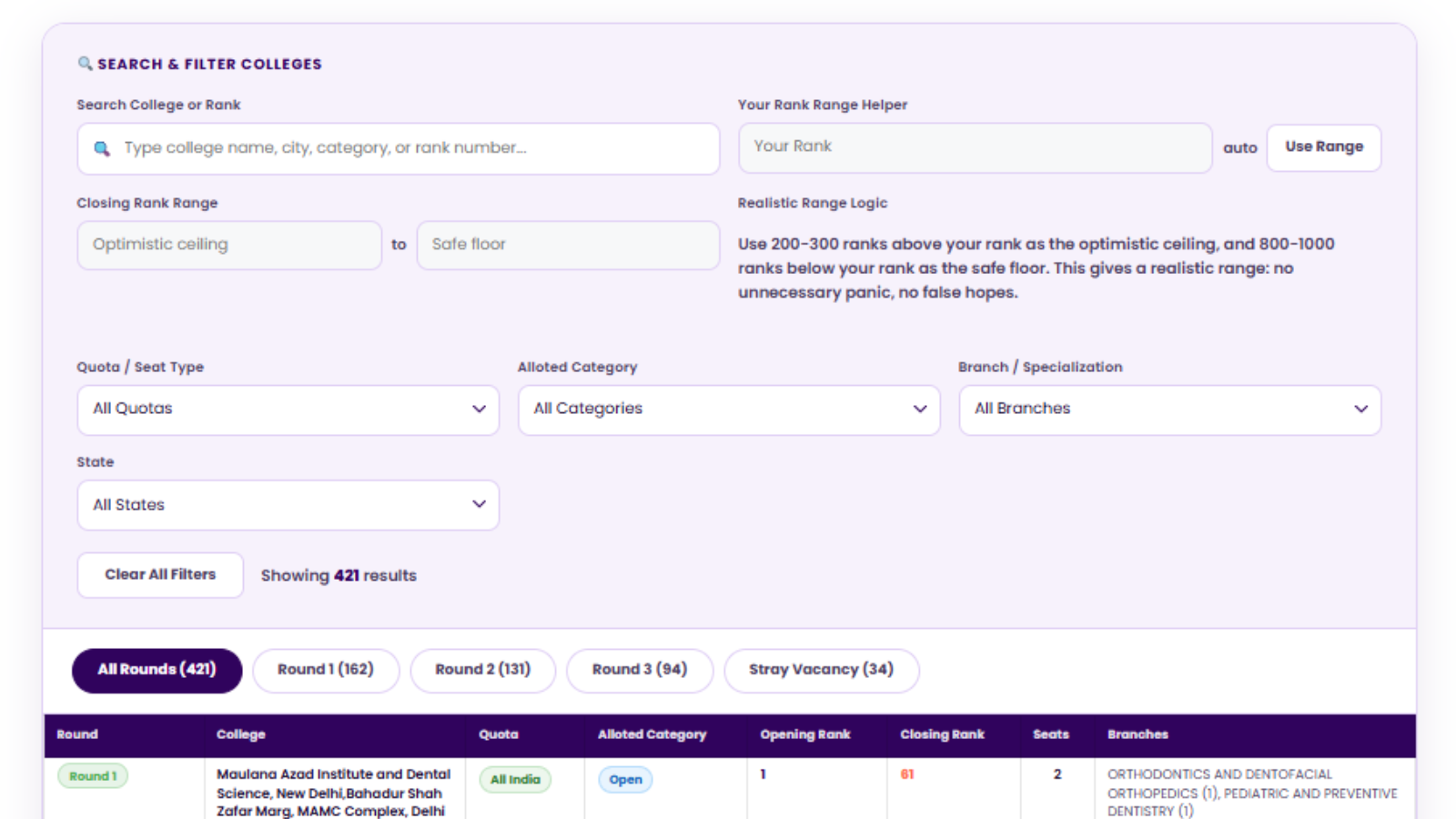
We analysed previous MCC allotment trends to build a practical prediction system. Not guesswork — real counselling data with realistic expectations.
Complete MCC round-wise data
General / EWS
Cutoff: 308 / 960 · Qualifying rank ceiling: ~15,229
| Tier | Marks range | Rank range | What it means |
|---|---|---|---|
| Excellent | 600 – 802 | 1 – 1,795 | Top-choice govt / central seats |
| Strong | 450 – 599 | 1,796 – 6,793 | Govt seats + good deemed options |
| Average | 350 – 449 | 6,794 – 12,148 | Private / deemed seats likely |
| Borderline | 308 – 349 | 12,149 – 15,229 | Qualified; limited seat availability |
| Disqualified | Below 308 | 15,230+ | Below Gen/EWS cutoff |
General PwBD
Cutoff: 289 / 960 · Qualifying rank ceiling: ~16,725
| Tier | Marks range | Rank range | What it means |
|---|---|---|---|
| Excellent | 600 – 802 | 1 – 1,795 | Competes with Gen open pool |
| Strong | 450 – 599 | 1,796 – 6,793 | Wide seat access incl. PwBD quota |
| Average | 350 – 449 | 6,794 – 12,148 | Good PwBD quota chances |
| Borderline | 289 – 349 | 12,149 – 16,725 | Qualified; depends on PwBD seat count |
| Disqualified | Below 289 | 16,726+ | Below Gen PwBD cutoff |
SC / ST / OBC (including PwBD of SC/ST/OBC)
Cutoff: 271 / 960 · Qualifying rank ceiling: ~18,245
| Tier | Marks range | Rank range | What it means |
|---|---|---|---|
| Excellent | 550 – 802 | 1 – 3,154 | Competes across all categories |
| Strong | 400 – 549 | 3,155 – 9,196 | Good reserved + open seat access |
| Average | 308 – 399 | 9,197 – 15,229 | Reserved category seats likely |
| Borderline | 271 – 307 | 15,230 – 18,245 | Qualified under SC/ST/OBC only |
| Disqualified | Below 271 | 18,246+ | Below SC/ST/OBC cutoff |
Counselling has started. Prepare your college choices using your rank, branch preference, budget, fees, and previous closing ranks before you lock your choices.
Built around your rank. Get a college shortlist with Round 1–3 predictions for MCC and your state counselling — delivered within 48 hours.
- Your rank analysed against actual closing data
- Safe, moderate and reach college categories
- MCC + up to 2 state counselling routes
- Round 1 to Round 3 allotment predictions
- Management and NRI quota assessment
- Personalised choice filling strategy
- Delivered to WhatsApp or Email
Full round-wise data for MCC and state counselling — opening and closing ranks, fee structures, bond rules, and choice filling strategy for 2026.
- College-wise opening and closing ranks
- All 4 MCC rounds + Stray Vacancy data
- Branch-wise and quota-wise analysis
- Fee structure and hidden charges
- Bond rules — state-wise
- Round-wise upgrade strategy
- Mistakes to avoid during choice filling
Not sure which one you need? Get the Personalised Report if you want a college shortlist based on your rank. Get the Counselling Guide if you want detailed round-wise data, fees, bond rules, closing ranks, and choice-filling strategy.
Real MCC Data: Opening vs Closing Ranks
| College Type | Round 1 | Round 2 | Round 3 (Mop-Up) | Stray Vacancy |
|---|---|---|---|---|
| Govt AIQ (Top Clinical Branches) | 1–500 | 1–800 | 1–1,200 | 1–1,500 |
| Govt AIQ (Other Branches) | 1–3,000 | 2,000–5,000 | 3,000–7,000 | 4,000–9,000 |
| Central Universities | 1–2,000 | 1–3,500 | 2,000–5,000 | 3,000–7,000 |
| Tier-1 Deemed Universities | 4,000–8,000 | 3,000–10,000 | 2,000–12,000 | 3,000–14,000 |
| Tier-2 Deemed Universities | 8,000–15,000 | 7,000–16,000 | 5,000–18,000 | 8,000–20,000 |
| Tier-3 Deemed Universities | 15,000+ | 12,000+ | 8,000–20,000+ | 10,000–25,000+ |
Important Trends from MCC Counselling
- Round 1: Best Government and Central University seats are usually allotted.
- Round 2: Moderate seat movement due to upgrades.
- Round 3 (Mop-Up): Maximum movement in Deemed University seats.
- Stray Vacancy Round: Highest closing ranks are generally seen here.
✍️My Take: Many candidates focus only on their rank and assume they have no chance of getting a seat. In reality, MCC counselling is often decided by choice filling strategy, participation in all rounds, and willingness to consider multiple colleges and branches.
Even candidates with ranks above 10,000–15,000 regularly secure MDS seats through Round 3 and Stray Vacancy counselling by staying active until the final round.
Important: The above analysis is based on historical MCC allotment trends. Actual cutoffs vary every year depending on specialization, category, seat availability, reservation rules, and the number of participating candidates.
NEET MDS MCC Counselling Participating Colleges
There are a total of 74 dental colleges which are participating in MCC counselling, out of this 35 are Government Institute, 34 are Deemed university and 5 central universities.
| Sl. | Code | College Name | State | Type |
|---|
NEET MDS MCC Counselling College Fees
One of the biggest misconceptions among aspirants is that the MCC counselling fee and the college fee are the same. They are completely different.
The fee paid during MCC registration only allows participation in counselling. The actual tuition fee, hostel fee, caution deposit, bank guarantee, and other charges are determined by the respective college.
MCC does not regulate or control college fees. Candidates are responsible for verifying the latest fee structure from the college website, official fee circular, or admission brochure before joining.
There are three distinctly different fee environments under MCC counselling.
Government Dental Colleges
50% All India Quota (AIQ) Seats
Government Dental Colleges generally offer the most affordable MDS education under MCC counselling.
| Component | Typical Range |
|---|---|
| Annual Tuition Fee | ₹40,000 – ₹80,000 |
| Stipend | ₹3,083 – ₹13,195 per month |
| Service Bond | Usually Applicable |
| Bond Penalty | State-Specific |
Government colleges are usually preferred because of:
- Low tuition fees
- Monthly stipend
- Strong patient flow and clinical exposure
- Better return on investment
Important: Even if admission is through MCC AIQ counselling, candidates must comply with the bond and service rules of the respective state and institution.
Central Universities
MAIDS, BHU & AMU
Central Universities generally offer a balance of affordability, academic reputation, and clinical exposure.
| Component | Typical Range |
|---|---|
| Annual Tuition Fee | ₹1,00,000 – ₹2,00,000 |
| Stipend | Available |
| Bond | Institution-Specific |
| Clinical Exposure | Usually High |
Why candidates prefer Central Universities:
- Established reputation
- Strong academics
- Good stipend structure
- Predictable fee environment
Deemed Universities
100% Seats Through MCC
Deemed Universities represent the largest fee variation under MCC counselling.
| Component | Typical Range |
|---|---|
| Annual Tuition Fee | ₹8,00,000 – ₹75,00,000+ |
| Bank Guarantee | Common Requirement |
| Stipend | ₹3,083 – ₹13,195 per month |
| Service Bond | Usually Not Applicable |
Most Deemed Universities do not impose compulsory government service obligations. However, many institutions may require:
- Bank Guarantee
- Advance Fee Payment
- Annual Fee Commitment
- Institutional Deposits
This is why Deemed Universities offer greater flexibility but usually involve a significantly higher financial commitment.
Additional Fees (Applicable Across Most Colleges)
Apart from tuition fees, candidates should also account for additional expenses.
| Component | Notes |
|---|---|
| Hostel Fee | Usually charged separately |
| Mess Fee | Generally payable per semester or year |
| Caution Deposit | Refundable in most institutions |
| University Charges | Varies by university |
| Examination Fee | Institution-Specific |
| Library / Miscellaneous Charges | May apply separately |
Understanding the Real Cost of an MDS Seat
Many candidates compare colleges only based on tuition fees. This often leads to poor decision-making.
Before joining any college, consider:
- Tuition Fee
- Hostel Charges
- Mess Charges
- Bond Liability
- Bank Guarantee Requirement
- Monthly Stipend
- Total Course Cost
True Cost Formula
Total Cost = Tuition Fee + Hostel Expenses + Other Charges + Bond Liability + Bank Guarantee Requirement – Stipend Received
A Government seat with a higher bond may sometimes be more expensive in the long term than expected, while a Deemed University seat with no service obligation may offer greater flexibility despite higher tuition fees.
Important Note
Fee structures, stipends, bank guarantee requirements, and bond obligations may change every year. Candidates should always verify the latest information from the official college website and admission notification before reporting to the allotted institute.
One-Line Takeaway
Never compare colleges only on tuition fees. Always evaluate the total financial commitment, including stipend, bond, hostel expenses, deposits, and bank guarantee requirements before making your final choice.
NEET MDS MCC Counselling Strategy
Many aspirants think counselling is only about rank. In reality, MCC counselling is a game of rank, strategy, and choice filling.
Every year, candidates with lower ranks secure better seats than candidates with higher ranks simply because they understand the counselling process better.
The most important insight from previous MCC rounds is:
Higher the round number → More seat movement → Higher closing ranks, especially in Deemed Universities.
Let’s understand the best counselling strategy based on your rank, counselling round, and financial planning.
Rank-Based Strategy
Different rank ranges require different approaches.
| Rank Band | Pattern Observed in MCC Counselling | Best Target Seats |
|---|---|---|
| AIR 1 – 3,000 | Government and Central University seats dominate | Govt AIQ + MAIDS + BHU + AMU |
| AIR 3,001 – 7,000 | Government lower branches and Tier-1 Deemed colleges become realistic | Govt (Lower Branches) + Tier-1 Deemed |
| AIR 7,001 – 12,000 | Maximum opportunities in Deemed Universities during Round 2 & 3 | Tier-1 & Tier-2 Deemed Colleges |
| AIR 12,000+ | Seat conversion depends heavily on Round 3 and Stray Vacancy | Tier-2 Deemed + NRI Backup |
AIR 1–3,000: Aim for the Best
Candidates in this range should aggressively target:
- Government AIQ Seats
- MAIDS
- BHU
- AMU
- Premium Clinical Branches
Since Round 1 offers Free Exit, candidates should not hesitate to include ambitious choices. If you receive a seat in Round 1, you must decide whether to Freeze the seat or Float for Round 2 upgradation.
📋Strategy: Aim high and use Round 1 aggressively.
AIR 3,001–7,000: Two-Step Strategy
Candidates in this range should keep both Government and Deemed options open.
Recommended approach:
- Try Government seats in Round 1.
- Use Round 2 and Round 3 for upgrades.
- Keep Tier-1 Deemed Universities as strong backup options.
📋Strategy: Government first, Tier-1 Deemed second.
AIR 7,001–12,000: Clinical Branch Focus
This is the rank range where counselling strategy becomes extremely important.
Many candidates in this bracket secure:
- Orthodontics
- Prosthodontics
- Pedodontics
- Conservative Dentistry
through Deemed Universities during Round 2 and Round 3.
📋Strategy: Focus on branch preference and stay active until Mop-Up Round.
AIR 12,000+: Seat-Secure Phase
Candidates above AIR 12,000 should focus on securing a seat rather than chasing unlikely upgrades.
Historically, the biggest rank movement happens during:
- Round 3 (Mop-Up)
- Stray Vacancy Round
Many candidates in this range receive allotments only in the later rounds.
📋Strategy: Participate in every round and maximize realistic choices.
Round-Based Strategy
Every counselling round behaves differently. Your strategy should change accordingly.
Round 1 (Free Exit Round)
| What Usually Happens | Your Strategy |
|---|---|
| Government and Central University seats fill quickly | Add all dream colleges and branches |
🔑Key Rule: Free Exit is available.
This is the best round to take calculated risks.
Round 2 (Commitment Round)
| What Usually Happens | Your Strategy |
|---|---|
| Government lower branches and upgraded seats become available | Final attempt for Government seats |
🔑Key Rule: No Free Exit.
Only fill choices that you are genuinely willing to join. If you want to upgrade from Round 2 to Round 3, you can give willingness for upgradation online under the 2026 Float system.
Round 3 (Mop-Up Round)
| What Usually Happens | Your Strategy |
|---|---|
| Massive seat movement in Deemed Universities | Aggressive choice filling |
This is often the most important round for:
- Deemed Universities
- Clinical Branches
- Rank upgrades
🔑Key Rule: Secure the best realistic seat available. Round 3 requires greater caution because candidates allotted a Round 3 seat must physically report and join. Once a candidate joins the Round 3 seat, resignation and further MCC participation are not allowed.
Stray Vacancy Round
| What Usually Happens | Your Strategy |
|---|---|
| Highest closing ranks and final seat conversions | Fill every realistic option |
Many candidates underestimate this round.
Historically, some of the highest closing ranks in MCC counselling are seen during Stray Vacancy.
🔑Key Rule: No experiments. Fill every realistic choice.
Best Order of Choices
MCC software always scans choices from top to bottom.
The software does not know your favorite college. It only knows the order you submit.
Universal Choice Order
Government AIQ
↓
Central Universities
↓
Tier-1 Deemed Universities
↓
Tier-2 Deemed Universities
↓
NRI Quota Seats
Best Choice Order by Rank
| Rank Category | Recommended Choice Order |
|---|---|
| AIR 1–3,000 | Govt → Central → Deemed Backup |
| AIR 3,001–7,000 | Govt → Tier-1 Deemed |
| AIR 7,001–12,000 | Tier-1 Deemed → Tier-2 Deemed |
| AIR 12,000+ | Tier-2 Deemed → NRI Backup |
Best Choice Order by Budget
| Annual Budget | Recommended Options |
|---|---|
| Less than ₹3 Lakh | Government & Central Universities |
| ₹6–15 Lakh | Tier-1 Deemed Universities |
| More than ₹20 Lakh | Deemed + NRI Options |
✨Golden Rule: Better choices should always be placed above safe choices.
Choice Filling Strategy
How Many Choices Should You Fill?
| Rank Range | Recommended Choices |
|---|---|
| AIR 1–3,000 | 40–60 Choices |
| AIR 3,001–7,000 | 70–100 Choices |
| AIR 7,001–12,000 | 100–150 Choices |
| AIR 12,000+ | 150+ Choices |
The lower your rank, the more choices you should fill.
When Should You Exit?
| Round | Exit Allowed? | Recommended Action |
|---|---|---|
| Round 1 | Yes | Take calculated risks |
| Round 2 | No Free Exit | Fill only safe options |
| Round 3 | No | Secure a seat |
| Stray Vacancy | No | Fill every realistic option |
Common Mistakes to Avoid:
- Filling only 10–15 choices.
- Mixing Government and Deemed colleges randomly.
- Ignoring Round 3 and Stray Vacancy.
- Chasing unrealistic colleges throughout all rounds.
- Forgetting to select the upgrade option after joining.
- Making choices without checking fees, bond rules, and stipend.
✍️My Take: A candidate’s counselling result is often decided by choice filling, not just by rank.
A well-prepared candidate with a realistic choice list, proper college research, and participation in all rounds usually performs much better than a candidate who only focuses on rank and cutoff data.
📜Remember: Rank gets you into the game. Strategy determines where you finish.
NEET MDS MCC Counselling Mistakes
Most candidates do not lose seats because of rank.
They lose seats because of avoidable counselling mistakes.
A candidate with a lower rank but a better counselling strategy often secures a better seat than a candidate with a higher rank but poor planning.
Let’s look at the most common mistakes made during MCC counselling.
1. Filling Too Few Choices
Many students fill only 10–20 choices thinking:
“I will get one of these colleges anyway.”
In reality, candidates who fill a larger and more realistic choice list usually perform better.
MCC software allocates the first available seat based on your rank and choice order. A limited choice list reduces your chances significantly.
📜Rule: Fill choices in this order:
Dream Colleges → Safe Colleges → Backup Colleges → NRI Options (if applicable)
2. Wrong Order of Choices
Many candidates place Deemed Universities above Government colleges without realizing the impact.
MCC software reads choices from top to bottom.
If a Deemed University appears above a Government college and becomes available at your rank, the software may allot the Deemed seat first.
📜Rule: Always arrange choices according to your true preference.
3. Forgetting to Opt for Upgradation
In 2026, candidates must understand the difference between Freeze and Float after seat allotment. Freeze means you do not want upgradation and must physically report to the allotted institute. Float means you want upgradation and will complete the applicable document verification process online.
Do not choose Freeze simply because you received a decent seat. If you want to participate in the next round for a better seat, you need to follow the Float process.
📜Rule: Always understand the upgrade option before reporting.
4. Waiting Until Later Rounds to Take Risks
Many candidates save their ambitious choices for Round 2 or Round 3.
This is usually the wrong approach.
Round 1 is the safest round for taking risks because Free Exit is available.
Government and Central University seats often close early.
📜Rule: Take calculated risks in Round 1, not in the later rounds.
5. Trusting Agents or Seat Brokers
Every year, candidates receive calls from agents claiming:
- Guaranteed MDS Seat
- Direct Admission
- Seat Blocking
- Management Quota Shortcut
MCC seat allotment is completely software-based.
No college, broker, consultant, or middleman can influence the allotment process.
📜Rule: If someone claims they can guarantee an MCC seat, treat it as a red flag.
6. Not Checking Fees Before Reporting
Many candidates reach the allotted college and discover:
- High tuition fees
- Bank guarantee requirements
- Non-refundable charges
- Hostel deposits
- Additional university fees
At that stage, options may be limited.
📜Rule: Verify fees, bank guarantee requirements, and refund policies before filling choices.
7. Ignoring Bond and Service Obligations
Some candidates focus only on college reputation and fees.
They completely ignore:
- Service bonds
- Bond penalties
- Mandatory government service
- Stipend conditions
This can create major financial and career consequences after MDS.
📜Rule: Check bond rules before joining, not after admission.
8. Not Preparing Documents in Advance
Document-related mistakes are among the most common reasons for admission problems.
Examples include:
- Missing internship certificate
- Invalid category certificate
- Expired documents
- Incomplete NRI documentation
A single missing document can delay or even cancel admission.
📜Rule: Prepare all documents before counselling begins. In 2026, candidates must also keep clear scanned copies ready because both Freeze and Float candidates must upload documents through the MCC portal. Float candidates may need to correct and re-upload documents if the institute raises a discrepancy.
9. Thinking Closing Rank Decides Everything
Many candidates see a previous year’s closing rank and assume they have no chance.
In reality:
- Seat movement continues through multiple rounds.
- Upgradations create new vacancies.
- Round 3 and Stray Vacancy often produce surprising results.
Counselling is dynamic.
📜Rule: Participate until the final eligible round.
10. Registering Multiple Times
MCC allows only one valid registration.
Multiple registrations may create complications and can lead to cancellation of candidature.
📜Rule: Register only once using your correct details.
11. Skipping Eligible Counselling Rounds
Some candidates stop participating after Round 1 or Round 2 because they assume all good seats are gone.
Historically, many Deemed University seats and even clinical branches become available in later rounds.
📜Rule: Stay active in every round for which you remain eligible.
Float candidates can continue pursuing upgradation through the applicable next round without physically reporting during the Round 1/2 online verification process.
12. Blindly Copying Someone Else’s Choice List
One of the biggest counselling mistakes is using another student’s preference sheet.
Remember:
- Their rank is different.
- Their budget is different.
- Their branch preference is different.
- Their career goals are different.
A choice list should be customized for your own situation.
📜Rule: Build your own preference list based on rank, budget, branch preference, fees, bond rules, and career goals.
✍️ My Take: Most counselling mistakes happen because candidates rush through choice filling and reporting. The candidates who perform best are usually not the ones with the highest ranks. They are the ones who:
- Research colleges properly
- Understand round-wise rules
- Fill enough choices
- Verify fees and bond conditions
- Participate until the final eligible round
⚠️Remember: Rank gets you an opportunity. Counselling strategy converts that opportunity into a seat.
NEET MDS MCC Counselling Final Checklist
If you have reached this section, you already know the counselling process, rounds, documents, fees, reservation rules, and strategy.
Now use this final checklist before participating in NEET MDS MCC Counselling 2026.
If the answer is “Yes” to all four questions, proceed confidently.
✍️My Take: Most counselling mistakes happen because candidates rush through registration, choice filling, or reporting. A simple checklist can prevent almost all major counselling errors.
✅Remember: Rank gets you an opportunity. Preparation ensures you don’t lose it.
Wrap Up
NEET MDS MCC Counselling is much more than just registration and choice filling. It is a structured process where your rank, strategy, choice order, financial planning, and understanding of the rules all work together to determine your final outcome.
Throughout this guide, we covered everything you need to know about MCC Counselling, including eligibility criteria, counselling rounds, reservation policies, bond rules, required documents, participating colleges, fees, rank analysis, counselling strategies, common mistakes, and the final checklist. If you have read this guide from start to finish, you now have a much better understanding of how the counselling process works and what steps you should take to maximize your chances of securing the best possible MDS seat.
Remember, many candidates focus only on their rank, but successful counselling is often decided by preparation and decision-making. A well-researched choice list, participation in all eligible rounds, proper document preparation, and awareness of fees and bond obligations can make a significant difference in your final result.
My advice is simple: Do not rush. Research carefully. Fill choices wisely. Understand the rules of every round. And always make decisions based on your career goals, branch preference, and budget.
I will continue updating this guide whenever MCC releases new notifications, schedules, seat matrices, or counselling updates, so make sure to bookmark this page and revisit it during the counselling season.
On behalf of the entire AspirantsOnly Research Desk, I wish you the very best for your NEET MDS counselling journey. I genuinely hope you secure the college and branch that helps you build the career you have always dreamed of.
Good luck with your Dental Dream, mate. My prayers will always be with you. 🙏🍀🤞
FAQs
Who is eligible for NEET MDS MCC Counselling?
To participate in NEET MDS MCC Counselling, a candidate must qualify NEET MDS, hold a BDS degree from a recognized dental college, complete the compulsory rotatory internship by the prescribed deadline, possess provisional or permanent registration with DCI/State Dental Council, and complete MCC registration. Eligibility remains provisional until document verification at the allotted college.
Is domicile required for MCC NEET MDS Counselling?
No. MCC counselling for 50% All India Quota (AIQ), Central Universities, and Deemed Universities is domicile-free. Candidates from any state in India can participate, subject to eligibility requirements.
Can I participate in MCC Counselling if I do not get a seat in Round 1?
Yes. Candidates who do not receive a seat in Round 1 can participate in subsequent rounds, subject to MCC eligibility rules. In fact, many seats become available in Round 2, Mop-Up Round (Round 3), and Stray Vacancy Round due to upgrades, resignations, and seat movement.
Is reservation available in Deemed Universities under MCC Counselling?
Generally, SC, ST, OBC-NCL, and EWS reservation is not applicable in most Deemed Universities. However, some institutions may have NRI quota seats or minority quota seats. For example, certain Deemed Universities such as Yenepoya Dental College offer Muslim Minority Quota seats. Candidates should always check the latest MCC seat matrix before choice filling.
What is the biggest mistake candidates make during MCC Counselling?
The most common mistake is poor choice filling. Many candidates fill too few choices, arrange colleges in the wrong order, ignore fees and bond obligations, or fail to participate in later counselling rounds. A well-planned choice list and participation in all eligible rounds often have a greater impact on the final outcome than rank alone.
What is the Freeze option in NEET MDS MCC Counselling 2026?
The Freeze option means that the candidate accepts the allotted seat and does not want an upgrade. A Freeze candidate must physically report to the allotted college and complete the admission process.
What is the Float option in NEET MDS MCC Counselling 2026?
The Float option means that the candidate accepts the allotted seat but wants a better seat in the next counselling round. A Float candidate can complete the applicable document verification online without physically reporting to the allotted college during the Round 1 and Round 2 process.
What is the difference between Freeze and Float in MDS admission?
Freeze means you want to keep your current seat. Float means you want to keep your current seat while trying for a better seat in the next round. Freeze requires physical reporting, while Float uses the applicable online document verification process.
Can I get an upgrade after choosing Float?
Yes. A Float candidate can participate in the next counselling round for upgradation. MCC allows upgradation from Round 1 to Round 2 and from Round 2 to Round 3.
Do Float candidates need to physically report to the college?
No. A Float candidate does not need to physically report to the allotted college during the applicable Round 1 or Round 2 process. The candidate must complete the required online document verification instead.
Do Freeze candidates need to report to the allotted college?
Yes. A Freeze candidate must physically report to the allotted institute. The candidate must submit the required original documents, complete verification, pay the required fees, and complete the admission process.
Do both Freeze and Float candidates need to upload documents online?
Yes. Both Freeze and Float candidates must upload scanned copies of the required documents on the MCC portal within the prescribed timeline. Float candidates use these documents for online verification.
What happens if the college finds a problem with my uploaded documents?
The allotted college can raise a query if it finds a problem with the uploaded documents. The candidate can then correct and re-upload the documents within the prescribed timeline. The college will verify the corrected documents again.
Is physical reporting required in every MCC counselling round?
No. The reporting requirement depends on the round and candidate status. Freeze candidates must physically report, while Float candidates can use online document verification during the applicable Round 1 and Round 2 process. Round 3 requires physical reporting for candidates who accept the allotted seat.